
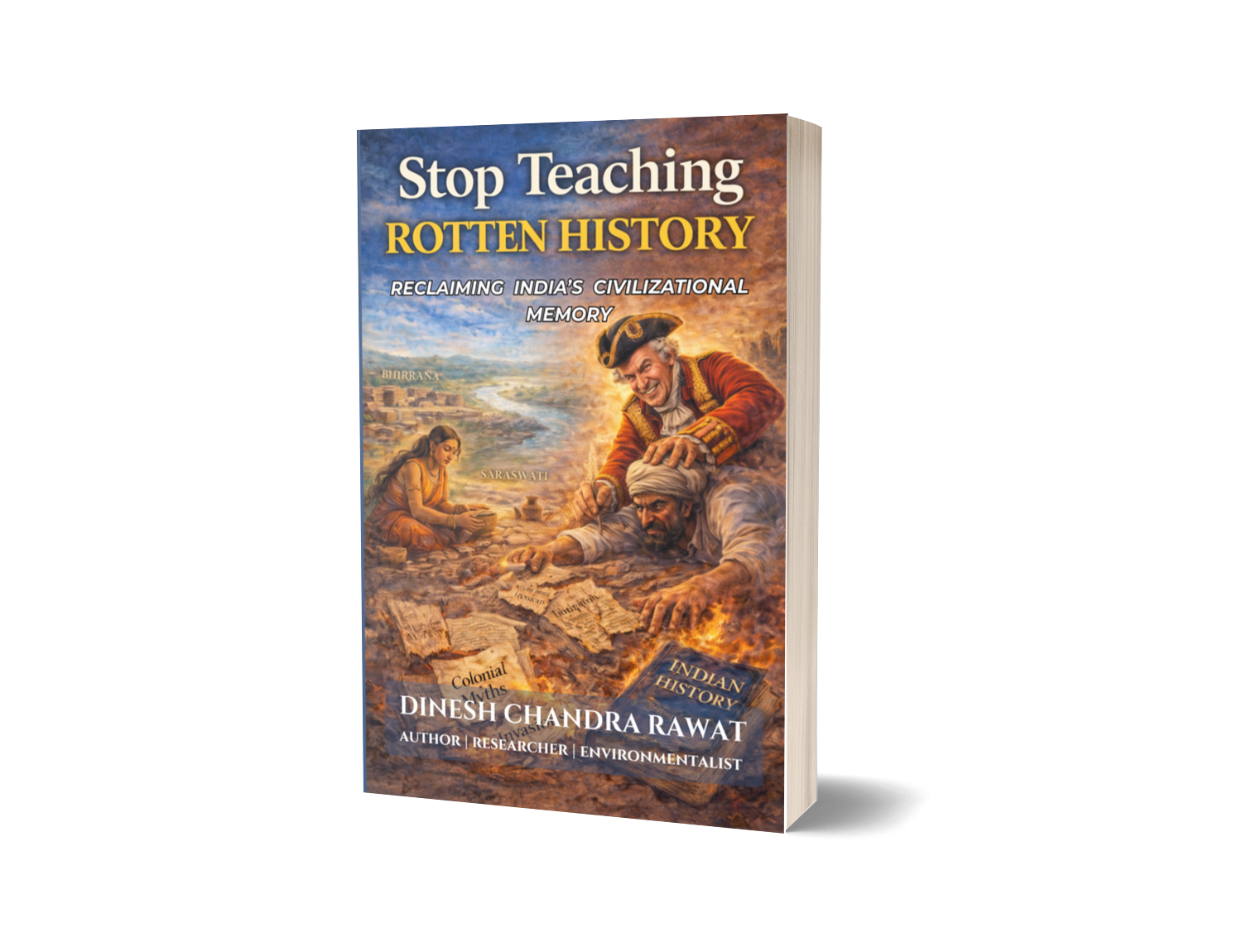
Author: Dinesh Chandra Rawat
language : English
Stop Teaching Rotten History
Reclaiming India’s Civilizational Memory from Colonial Distortion
For generations, history has been taught not as remembrance—but as reduction.
Stop Teaching Rotten History is a bold, evidence-driven examination of how India’s past was systematically distorted through colonial frameworks and how those distortions continue to shape education, identity, and self-perception today.
This book does not argue from emotion or blind pride. It argues from continuity, memory, archaeology, ecology, philosophy, and lived civilizational evidence.
Dinesh Chandra Rawat challenges long-standing academic assumptions and inherited narratives, asking uncomfortable but necessary questions:
- Is history ever neutral?
- Why was India’s timeline artificially shortened?
- How did colonial education break civilizational memory?
- Why were rivers like Sarasvati declared “mythical”?
- How did speculative theories become textbook dogma?
- Why are Indian knowledge systems treated as belief rather than intelligence?
Rather than presenting history as a sequence of invasions and rulers, this book restores history as civilizational consciousness—rooted in rivers, rituals, festivals, ecological wisdom, oral precision, and philosophical inquiry.
📚 What This Book Covers
✔ How colonial education reshaped Indian self-perception
✔ The psychological impact of distorted history
✔ Timeline compression and the invention of “prehistory”
✔ The Aryan Invasion Theory as academic inertia
✔ Sarasvati River: memory versus maps
✔ Knowledge before writing and cities
✔ Observation before theory
✔ Evolution, assumption, and civilizational meaning
✔ Nalanda to colonial universities
✔ Festivals, folk traditions, and women’s voices as historical memory
✔ Youth as custodians of civilizational responsibility
✔ Rewriting history curricula with dignity and balance
🎯 Who This Book Is For
- Students and educators questioning inherited history
- Parents concerned about identity-based education
- Scholars and researchers of Indian civilization
- Policymakers and curriculum designers
- Readers seeking clarity beyond colonial narratives
- Anyone who believes history should orient, not humiliate
This is not a call to glorify the past.
It is a call to remember it responsibly.
If history is taught truthfully, it does not divide—it heals.
If history is taught with continuity, it empowers the future.
Biplab Samanta –
This book made me rethink what I unknowingly pass on to my students.
Clear, grounded, and deeply relevant for educators and parents.
Avinash Roy –
Stop Teaching Rotten History – Reclaiming India’s Civilizational Memory is a powerful and thought-provoking Indian history book that questions the colonial and biased narratives taught in traditional textbooks.
Dinesh Rawat presents Indian civilization from a fresh perspective, encouraging readers to think critically and rediscover India’s true cultural and historical roots. The language is simple, making it easy for students and general readers.
This book is ideal for anyone interested in real Indian history, civilizational studies, and decolonizing the Indian education system.