
Should History Ever Be Considered Settled?
There is a sentence I have increasingly found myself questioning:
“History has already established this.”
Established by whom? On the basis of which evidence? At what point in time? And what happens when new evidence appears?
These questions do not mean that every historical conclusion is wrong. Nor do they mean that we should discard scholarship merely because we dislike its conclusions.
They mean something much simpler:
History must remain open to evidence.
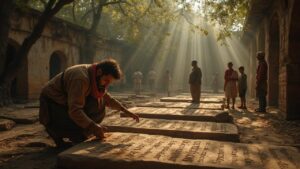
For more than three decades, my own exploration of India has repeatedly brought me face to face with the difference between the history we receive and the much larger past that survives in archaeological sites, monuments, landscapes, inscriptions, traditions and local memories.
The more I explored, the less comfortable I became with the idea that history should be treated as a finished product.
History Is Not Merely a Collection of Dates
Many of us first encounter history in school as a sequence:
King A came after King B.
A war occurred in a particular year.
One dynasty defeated another.
A ruler built a monument.
An empire rose and eventually disappeared.
These facts have value.
But history is much more than chronology.
The real questions begin afterward:
Why did something happen?
How reliable is the source describing it?
What evidence survived?
What evidence disappeared?
Are written records supported by archaeology?
Could a later discovery change the interpretation?
Do different sources describe the same event differently?
Once these questions begin, history becomes an investigation rather than a catalogue.
We Have Already Seen History Change
Consider a simple fact.
A little more than a century ago, the world did not possess anything close to today’s understanding of the civilization represented by Harappa and Mohenjo-daro.
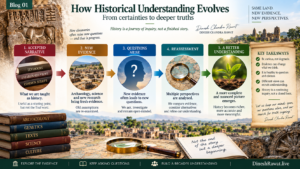
Archaeological investigation transformed that situation. Entire cities, material cultures, trade relationships, seals, technologies and settlement patterns became part of the discussion of India’s ancient past. The past itself had not changed.
Our evidence had changed.
And therefore our understanding changed. The same principle applies whenever an inscription is deciphered, an archaeological site is excavated, a manuscript is studied, a geological investigation changes our understanding of an ancient landscape, or a scientific technique allows material to be dated more accurately.
Evidence and Interpretation Are Different Things
This distinction is fundamental.
An archaeological object is evidence.
Its interpretation is an argument.
A written text is evidence.
What the historian concludes from the text requires interpretation.
An inscription may establish that a ruler, institution, donation, conflict or place existed.
It may not automatically establish every larger conclusion someone wishes to draw from it.
This is why serious historical inquiry requires humility.
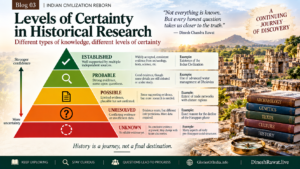
We should be willing to say:
This is strongly established.
This is probable.
This remains disputed.
This is an interesting possibility requiring more evidence.
There is no weakness in making these distinctions.
On the contrary, they strengthen the credibility of historical investigation.
Why India Especially Needs Open Questions
India presents an extraordinary challenge to historians.
Its civilizational record is immense.
We have archaeological remains, inscriptions, coins, monuments, philosophical traditions, religious texts, literary compositions, astronomical references, oral traditions, regional histories, temple records, foreign travellers’ accounts and colonial archives.
These sources were created in different periods and for very different purposes.
They do not always agree.
Some have been carefully studied.
Others remain incompletely explored.
Some archaeological sites have been extensively excavated.
Many others have not.
Even today, archaeological investigation continues across India.
It would therefore be intellectually strange to insist that every major question concerning such a vast civilization has already been permanently answered.
The Danger of Two Extremes
There are two approaches I believe we must resist.
The first says:
“The textbook says it, therefore it must be final.”
The second says:
“An ancient tradition says it, therefore every detail must be historically proven.”
Neither approach is sufficient.
Tradition deserves respect and investigation.
Scholarship deserves respect and scrutiny.
Archaeology deserves careful interpretation.
Scientific evidence deserves examination.
And every major claim should ultimately face the same question:
What is the evidence?
Questioning History Is Not the Same as Rewriting It
The expression “rewriting history” is often used negatively.
But historians revise historical understanding constantly.
They do so because new documents emerge, archaeological discoveries are made, older assumptions are challenged, methodologies improve and neglected perspectives become visible. The issue therefore is not whether history should ever be rewritten.
The real issue is:
What justifies revision?
If revision is driven only by political convenience, pride or hostility, we should be suspicious.
If revision is driven by stronger evidence, better methodology and a fuller body of sources, refusing to reconsider an old conclusion would itself be unhistorical.
A Question That Changed My Own Journey
Over the years I gradually stopped asking:
“What version of Indian history should I believe?”
I began asking instead:
“What explanation best accommodates the total evidence available?”
That is a more difficult question.
It sometimes confirms what we already believed.
Sometimes it complicates it.
Sometimes it forces uncomfortable reconsideration.
But that is exactly what intellectual inquiry is supposed to do.
The Past Deserves Curiosity, Not Fear
India does not need a history created merely to make Indians proud.
Nor should Indians be expected to preserve historical interpretations simply because they became conventional.
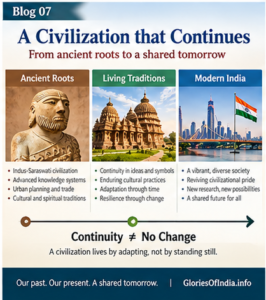
A civilization with India’s depth should have the confidence to examine its past rigorously.
We can respect scholarship while questioning conclusions.
We can value tradition while testing claims.
We can acknowledge uncertainty without abandoning inquiry.
And we can change our minds when evidence requires it.
That is not an attack on history.
That is how history remains alive.