
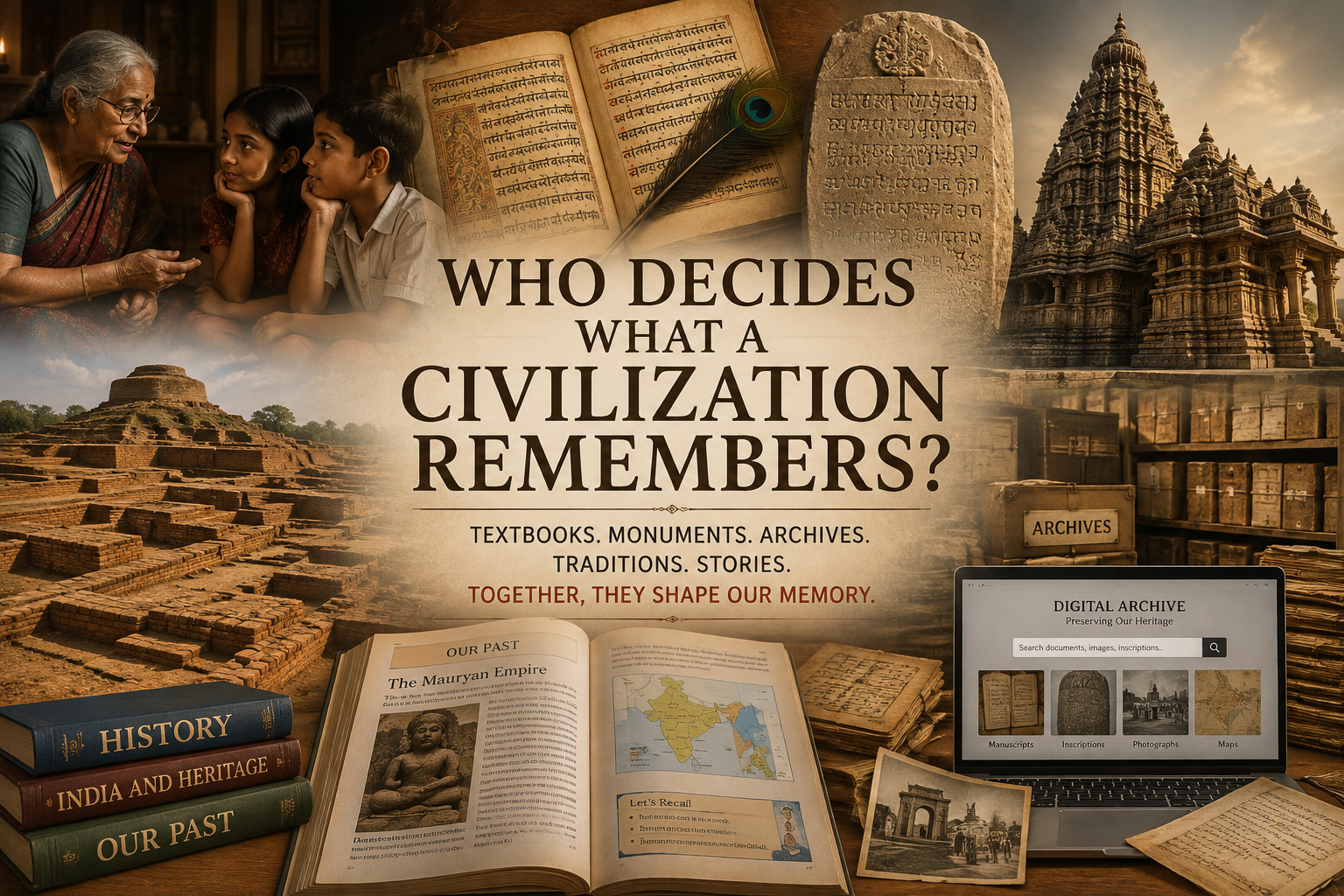
Who Decides What a Civilization Remembers?
Civilizations remember in strange ways.
A king may disappear from popular memory while an ancient pilgrimage survives.
A dynasty may dominate textbooks while the lives of millions of ordinary people receive only a few paragraphs.
A ruined monument may preserve information that no surviving manuscript records.
A grandmother’s story may carry the memory of a place for generations, yet never enter an archive.
This raises a question that has increasingly interested me:
Who decides what a civilization remembers?
The answer is not one person or institution.
Civilizational memory is created through many overlapping channels—and each preserves only part of the past.
The Textbook Is Powerful—but It Is Not the Past
For most people, school is their first organised encounter with history.
That gives textbooks enormous influence.
What receives ten pages appears important.
What receives ten lines appears less important.
What is omitted may disappear entirely from a student’s historical imagination.
But a textbook faces unavoidable limitations.
Thousands of years of history must be compressed into a few hundred pages.
Editors select.
Curriculum committees prioritise.
Periods are divided.
Some rulers become representative of entire centuries.
Complex debates are simplified.
None of this automatically proves bias.
Selection is unavoidable.
But selection has consequences.
The textbook is therefore not “history itself.”
It is a highly compressed representation of history.
Archives Also Remember Selectively
Written archives feel authoritative because documents appear concrete.
Yet archives are also products of survival.
Some governments kept extensive records.
Others did not.
Some documents survived war, humidity, insects and political upheaval.
Others vanished.
Elite institutions usually produced more written records than ordinary families.
Administrative archives naturally preserve what administrators considered important.
Court chronicles often describe rulers better than farmers.
A tax register may reveal economic life while saying almost nothing about spiritual or intellectual life.
Every archive therefore illuminates certain parts of the past while leaving others in darkness.
Monuments Remember Differently
A monument does not explain itself.
But it can preserve evidence that documents cannot.
Architecture may reveal engineering knowledge.
Temple inscriptions may preserve donations and lineages.
Water systems can reveal environmental adaptation.
Urban layouts can indicate planning.
Burial sites can offer clues about social practices.
Material remains often survive where literary records do not.
This is one reason archaeology has such importance in reconstructing ancient societies.
Then There Is Living Memory
India adds another dimension.
Many aspects of cultural memory have been transmitted not primarily through government archives but through communities.
Pilgrimage routes.
Festivals.
Genealogies.
Temple traditions.
Sacred geography.
Oral narratives.
Recitation.
Place names.
Ritual practices.
Local stories.
These are not automatically literal proof of every historical event associated with them.
But neither should they be dismissed as meaningless merely because they were transmitted outside modern academic institutions.
They can preserve questions.
And sometimes the right historical question begins with something a community refused to forget.
Remembering and Proving Are Different
This distinction is vital.
If a community has remembered an event for centuries, the existence of that memory is itself historically interesting.
But the details of the remembered event still require investigation.
We should therefore distinguish between:
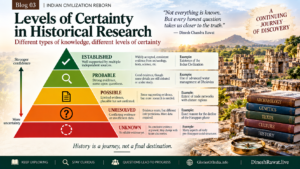
Memory: what people preserved.
Evidence: what survives that can be investigated.
Interpretation: what we conclude from that evidence.
Confusing these categories creates problems in both directions.
One extreme treats every inherited story as literal history.
The other assumes that anything transmitted through tradition has no historical value.
A better approach is to investigate.
Civilizations Can Also Forget
Forgetting does not always require a conspiracy.
Languages change.
Scripts become unreadable.
Institutions collapse.
Libraries burn.
Cities decline.
Political centres move.
Educational priorities change.
Communities migrate.
Old intellectual traditions may no longer have practitioners capable of interpreting their own technical literature.
Sometimes the meaning of a surviving object is lost even though the object itself remains.
One striking illustration is inscriptional history.
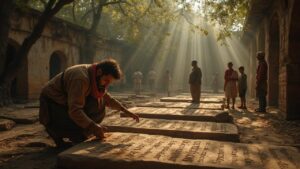
Ancient inscriptions could physically survive for centuries even after the ability to read their scripts had been lost.
When scripts were eventually deciphered, mute stones became historical documents again.
The civilization had preserved the object—but temporarily lost the ability to hear its message.
Modern Technology Is Changing Memory Again
Something extraordinary is now happening.
Digitisation is making historical material accessible on a scale earlier generations could scarcely imagine.
Inscriptions can be photographed and catalogued.
Manuscripts can be scanned.
Archaeological records can be compared.
Old maps can be georeferenced.
Remote sensing can reveal ancient landscape patterns.
Scientific analysis can examine materials invisible to the naked eye.
Digital repositories can make sources available to researchers thousands of kilometres away.
This means civilizational memory is entering a new stage.
The question is no longer only:
What survived?
It is increasingly:
What can we recover, connect and understand?
The Responsibility of Our Generation
Every generation inherits a historical record.
But it also makes decisions about what the next generation will receive.
What will we digitise?
What will we excavate?
Which languages will we teach?
Which monuments will we preserve?
Which manuscripts will we catalogue?
Which local traditions will we record before their custodians disappear?
Which historical questions will students be permitted to ask?
These are not abstract questions.
They determine what future Indians will be able to know about their own civilization.
Memory Should Lead to Inquiry
My interest in India’s civilizational memory does not arise from a desire to prove that every inherited belief is historically correct.
It arises from the opposite conviction:
Important memories deserve investigation.
If archaeology supports them, we learn something.
If archaeology challenges them, we learn something.
If the answer remains uncertain, that uncertainty itself deserves honest acknowledgement.
A civilization confident in itself should not fear any of these outcomes.
What Should India Remember?
Perhaps the wrong question is:
“Who controls history?”
A more productive question is:
“How can we preserve enough evidence, memory and intellectual freedom for future generations to investigate the past honestly?”
Textbooks matter.
Archives matter.
Archaeology matters.
Inscriptions matter.
Literature matters.
Oral traditions matter.
Scientific methods matter.
And, above all, the willingness to keep asking questions matters.
A civilization does not preserve its memory merely by celebrating the past.
It preserves its memory by continuing to investigate it.