
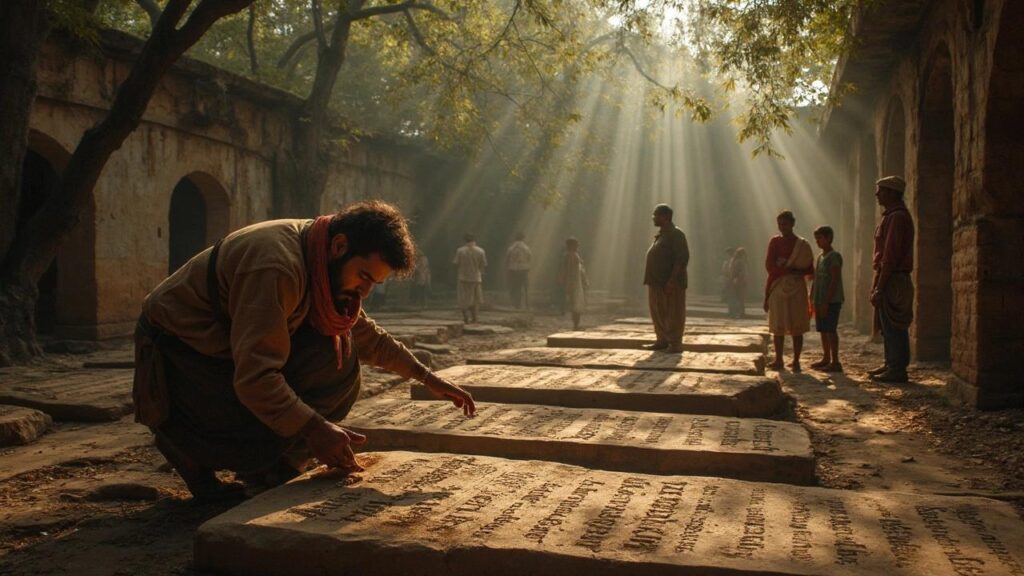
History has occupied a large part of my life for more than thirty-five years. What began as curiosity gradually became a sustained journey through historical sites, books, manuscripts, conversations and the many landscapes in which India’s past remains visible.
This long journey has also shaped my work as an Indian history researcher, encouraging me to examine inherited narratives alongside evidence from different disciplines.
I have travelled, met local people, spoken with historians, examined historical places and compared accounts that did not always agree. Over time, one question became increasingly important to me:
How do we know that the history we have inherited represents the fullest account the available evidence can support?
This question has shaped my writing. It does not mean that every established historical conclusion is wrong, nor that every traditional account must be accepted literally. It means that a civilization’s past deserves investigation without fear of uncomfortable evidence.
Readers who wish to know more about the broader journey behind this work can also explore About Dinesh Rawat
The Difference Between Visiting a Place and Reading About It
A textbook gives us an organised account. A historical site gives us a different experience.
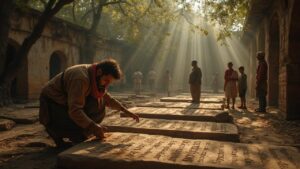
Standing before an ancient structure, walking through a settlement, or observing the remains of a once-important landscape can raise questions that a short textbook chapter cannot answer.
Who built this? What evidence supports the date assigned to it? What did the surrounding community remember? How did the geography change? Which parts of its history are firmly documented, and which are interpretations?
Site visits do not automatically make a person an expert. They can, however, reveal how much remains to be investigated. They encourage the researcher to return to written sources with more precise questions.
That has been one of the most valuable lessons of my journey.
Why I Began Comparing Different Sources
India’s historical record is unusually rich and varied. Archaeology, inscriptions, coins, manuscripts, architecture, literary traditions, scientific analysis and oral memory can each preserve a different part of the past.
But they do not all answer the same questions.
An inscription may establish a ruler’s name or a donation. Archaeology may reveal settlement patterns. A literary text may preserve ideas and cultural memory. Geological research may reconstruct an ancient river system.
The challenge is to examine where these sources converge and where they disagree.
This approach is central to the principle of evidence before interpretation, which guides much of my civilizational research.
I gradually became less interested in choosing the version of history I preferred and more interested in asking:
What explanation best accommodates the evidence as a whole?
India’s Achievements Deserve Serious Study
One subject that has especially interested me is the scientific and technological history of India.
Ancient and medieval Indian scholarship produced important developments in mathematics, astronomy, medicine, metallurgy, architecture and water management. These are not matters that require exaggeration to be significant.
The achievements of Aryabhata and Brahmagupta, the sophisticated water systems of Harappan settlements, and the long history of Indian metalworking are substantial subjects in their own right.
At the same time, it is important to distinguish a documented achievement from a modern interpretation of it. A claim that ancient India possessed a particular technology must be supported by appropriate archaeological, textual or scientific evidence.
Civilizational confidence is strengthened by accuracy, not by making every achievement older or more extraordinary than the sources justify.
Colonial Interpretations and Their Legacy
Another area of my interest concerns the influence of colonial rule on the way India’s history was studied and taught.
Colonial scholars made important contributions through archaeology, epigraphy, philology and manuscript preservation. Some also interpreted Indian society through assumptions shaped by their own time and the institutions of empire.
Both realities deserve examination.
The responsible approach is neither to reject scholarship because it was produced under colonial rule nor to treat inherited interpretations as permanently beyond question.
We should return to the sources, identify the assumptions, compare later discoveries and ask which conclusions remain persuasive.
That is the kind of re-examination I believe India needs.
Why Chronology Matters
Historical dates often appear more certain in popular writing than they really are.
Some are supported by contemporary inscriptions or well-established archaeological sequences. Others are estimates based on textual interpretation or incomplete evidence.
My interest in India’s chronology has led me to examine questions involving ancient settlements, civilizational continuity and the relationship between textual traditions and archaeological discoveries.
But an earlier date is not automatically a better date.
A chronology should be accepted because the evidence supports it, not because it makes a civilization appear more ancient.
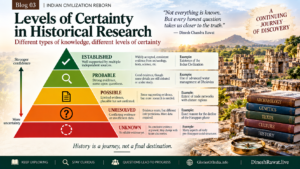
For that reason, I believe historical writing should clearly distinguish what is established, what is probable, what is possible and what remains speculative.
From Exploration to Writing
My books on Indian history and civilization grew out of this long process of questioning, comparison and reflection.
Stop Teaching Rotten History is intended to encourage readers, particularly younger generations, to examine how historical narratives are formed and why evidence matters.
Indian Civilization Reborn develops a broader investigation into India’s civilizational past, bringing together questions of chronology, archaeology, culture, geography and historical interpretation.
These works form part of my wider Glories of India and civilizational writing, which brings together books and research developed through decades of exploration.
Other works in my research programme continue to explore specific questions and themes.
These books should be read as invitations to examine arguments and evidence, not as substitutes for independent inquiry.
What I Hope Readers Will Take Away
I do not expect every reader to agree with every conclusion I reach.
In fact, disagreement supported by evidence is valuable.
What I hope to encourage is a more serious habit of questioning:
What is the original source?
How was it dated?
Does archaeology support the interpretation?
Are there competing explanations?
What evidence would change our minds?
These questions are useful far beyond Indian history. They are part of the discipline of thinking critically.
Readers can also explore my wider work as an author and the subjects that have developed through this continuing journey.
A Civilization Should Not Fear Inquiry
India’s past is too extensive and complex to be reduced to a single political narrative, a single textbook or a single author’s interpretation.
It deserves the combined efforts of archaeologists, historians, scientists, linguists, local communities and independent researchers.
My own contribution is one part of that larger effort.
After thirty-five years, I remain convinced that the most important question is not whether history makes us proud.
It is whether we are willing to pursue the truth with sufficient patience, humility and intellectual independence.
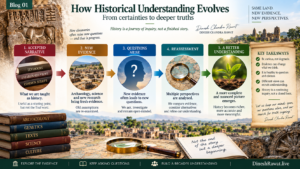
The past cannot be changed. Our understanding of it can—and should—continue to improve.
If you would like to explore the books, research themes or discuss this work further, you can contact the author