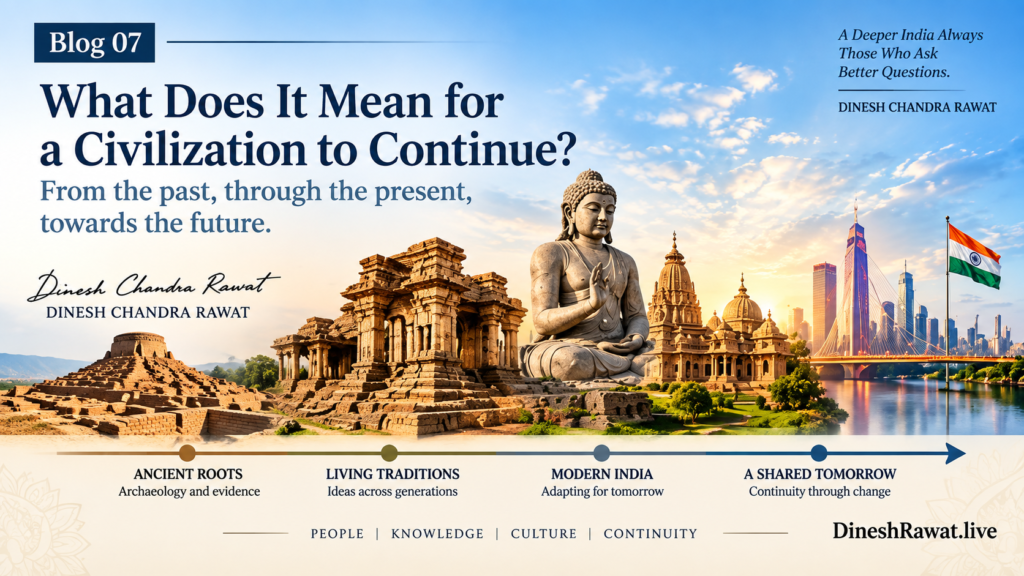
 What Does It Mean for a Civilization to Continue?
When we speak about the “continuity” of Indian civilization, what exactly are we claiming?
Do we mean that everything has remained unchanged for thousands of years?
That cannot be true of any living civilization.
Languages evolve. Political systems rise and disappear. Cities are built and abandoned. Religious and philosophical traditions develop new schools. Communities encounter one another. Technologies change.
And yet civilizations can continue.
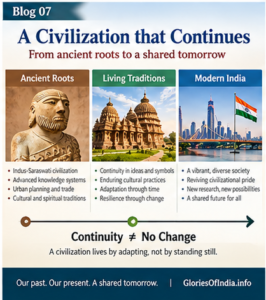
Continuity Does Not Mean Nothing Changed
I believe this distinction is essential.
If we define continuity as perfect sameness, almost no civilization could qualify.
A living civilization changes precisely because people continue to engage with it.
They reinterpret texts. They modify rituals. They translate ideas into new languages. They adapt institutions to new circumstances. They inherit some practices, abandon others and create new forms around older principles.
The better question is therefore not:
Has India remained unchanged?
It is:
What has been transmitted, transformed, remembered and repeatedly renewed?
Archaeological Continuity and Cultural Continuity Are Different Questions
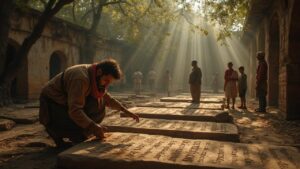
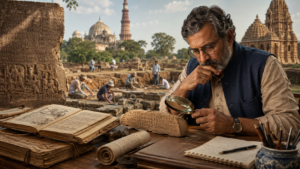
Archaeology gives us material evidence: settlements, pottery, buildings, tools, food remains, burials and changes in landscape use.
At a site such as Dholavira, archaeology can document a long sequence of habitation and transformation. UNESCO describes the settlement as occupied for roughly 1,500 years, with changes across early, mature and late Harappan phases. That is continuity of habitation at a particular archaeological site—not by itself proof that every later Indian cultural practice descended directly from Dholavira.
UNESCO’s Dholavira documentation is useful precisely because it shows both persistence and change.
Cultural continuity asks a different question.
It concerns ideas, practices, symbols, institutions, knowledge, memory and ways of life that communities transmit and reinterpret.
These two kinds of evidence can sometimes illuminate each other. But resemblance alone is not proof of uninterrupted continuity.
What Actually Continues?
There is no single object called “civilization” that passes intact from one generation to the next.
What continues are many interconnected things.
Ways of thinking about knowledge. Philosophical questions. Sacred geographies. Forms of worship. Literary traditions. Artistic conventions. Concepts of duty and social obligation. Food practices. Festivals. Systems of teaching. Craft knowledge. Ideas about the relationship between human life and nature.
Some survive for very long periods. Others disappear. Some merge with new influences. Some are revived after periods of decline.
This is why continuity is better understood as a pattern of transmission than as a claim of perfect sameness.
Transmission Matters More Than Immutability
UNESCO’s framework for intangible cultural heritage provides a useful modern analogy. It describes living heritage as expressions that communities recognize as part of their heritage and emphasizes that such traditions evolve as societies grow and adapt. UNESCO’s explanation of intangible cultural heritage therefore treats adaptation as compatible with continuity rather than its opposite.
India provides many examples of living transmission. UNESCO’s Indian intangible-heritage listings include Vedic chanting, Ramlila, Kutiyattam Sanskrit theatre, Yoga, Kumbh Mela, Durga Puja and Garba, among others.
Yoga is especially instructive. UNESCO notes both traditional master–pupil transmission and modern transmission through ashrams, educational institutions, community centres and other channels. The form of transmission changes while the practice continues to be taught and reinterpreted. See UNESCO’s Yoga entry.
Change Can Be Evidence of Survival
We often imagine continuity and change as opposites.
I increasingly think that is a mistake.
A tradition that cannot adapt may become a museum object. A tradition that can respond to new conditions may remain socially meaningful.
India has encountered migrations, political transformations, new religions, new languages, foreign rule, industrialization, modern science and globalization.
Continuity does not require pretending these encounters never happened.
The more interesting question is how older traditions interacted with them—sometimes resisting, sometimes absorbing, sometimes transforming and sometimes being transformed.
A civilization may remain recognizably itself while changing profoundly.
Avoid the Two Extremes
There are two simplified stories that I find equally unsatisfactory.
The first says that almost everything in modern India is new, disconnected from the ancient past.
The second says that essentially nothing important has changed for thousands of years.
Both approaches make historical investigation too easy.
The evidence is more complicated.
Some traditions show strong documented transmission. Some similarities are suggestive but uncertain. Some practices are clearly later developments. Some old forms disappeared entirely.
Responsible history should be able to say which is which.
This is why I return so often to the principle developed in “We Do Not Know Yet”: an open question is not a weakness. It is an invitation to investigate more carefully.
Why Indian Civilization Reborn Uses the Word “Reborn”
The word reborn can be misunderstood.
I do not use it to suggest that Indian civilization died and must somehow be recreated exactly as it existed in antiquity.
Nor do I mean that modern India should attempt to freeze itself in an imagined ancient form.
I use reborn in the sense of renewed understanding.
Much of India’s past is being reconsidered as archaeology expands, scientific techniques improve and different categories of evidence are compared.
To me, rebirth means recovering questions that were neglected, re-examining conclusions that became too fixed, recognizing achievements that evidence supports and discarding claims that evidence does not support.
A Civilization Continues When People Keep Reinterpreting It
Ultimately, a civilization does not survive because scholars declare it continuous.
It survives because generations of people continue to find meaning in inherited ideas and practices.
They learn them, argue about them, modify them, celebrate them, criticize them and pass some of them onward.
This is why living traditions matter.
UNESCO’s recognition of practices such as Yoga and Kumbh Mela emphasizes community transmission, while its broader heritage framework explicitly recognizes living heritage as evolving.
The evidence for Indian civilizational continuity therefore cannot come from one excavation, one text, one ritual or one genetic study.
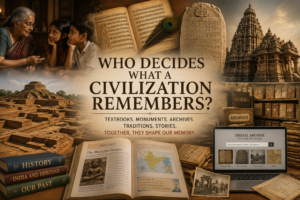
It must emerge from a much larger comparison of archaeology, texts, languages, institutions, knowledge traditions, art, philosophy and living practice.
That is the investigation I believe is worth pursuing.
Key Takeaways
- Civilizational continuity does not mean that nothing changed.
- Archaeological continuity and cultural continuity are related but different historical questions.
- Living traditions survive through transmission, reinterpretation and adaptation.
- Resemblance between an ancient artefact and a modern practice is not, by itself, proof of uninterrupted continuity.
- Change can be part of how a civilization survives.
- “Reborn” means renewed, evidence-based understanding—not an attempt to recreate ancient India unchanged.
Continue Exploring
On DineshRawat.live: Why I Stopped Accepting History as a Finished Story · The Most Important Words in Historical Research: “We Do Not Know Yet” · What I Learned from Disagreeing with Historians
Related research: Dholavira and the Engineering of Water · Rakhigarhi Ancient DNA on GloriesOfIndia.info.
Frequently Asked Questions
Does civilizational continuity mean there was no historical change?
No. Continuity can coexist with major changes in language, politics, technology, social institutions and religious expression. The question is what was transmitted and how it was transformed.
Can archaeology prove that a modern tradition is thousands of years old?
Sometimes archaeology can establish earlier material practices, but connecting them directly to a modern tradition usually requires additional evidence. Visual resemblance alone is not enough.
What evidence can be used to study Indian civilizational continuity?
Archaeology, texts, linguistics, art history, inscriptions, environmental evidence, histories of institutions and knowledge systems, and documented living traditions can all contribute—provided each is used for questions it can genuinely answer.
What does “Reborn” mean in Indian Civilization Reborn?
It means renewed investigation and understanding: revisiting India’s civilizational story with a wider evidence base while remaining open to revision.
From Continuity to Reconstruction
Indian Civilization Reborn asks what India’s civilizational story looks like when archaeology, geography, texts, science, knowledge systems and living traditions are examined together—with continuity neither assumed nor dismissed in advance.
Selected References
UNESCO — Intangible Cultural Heritage