
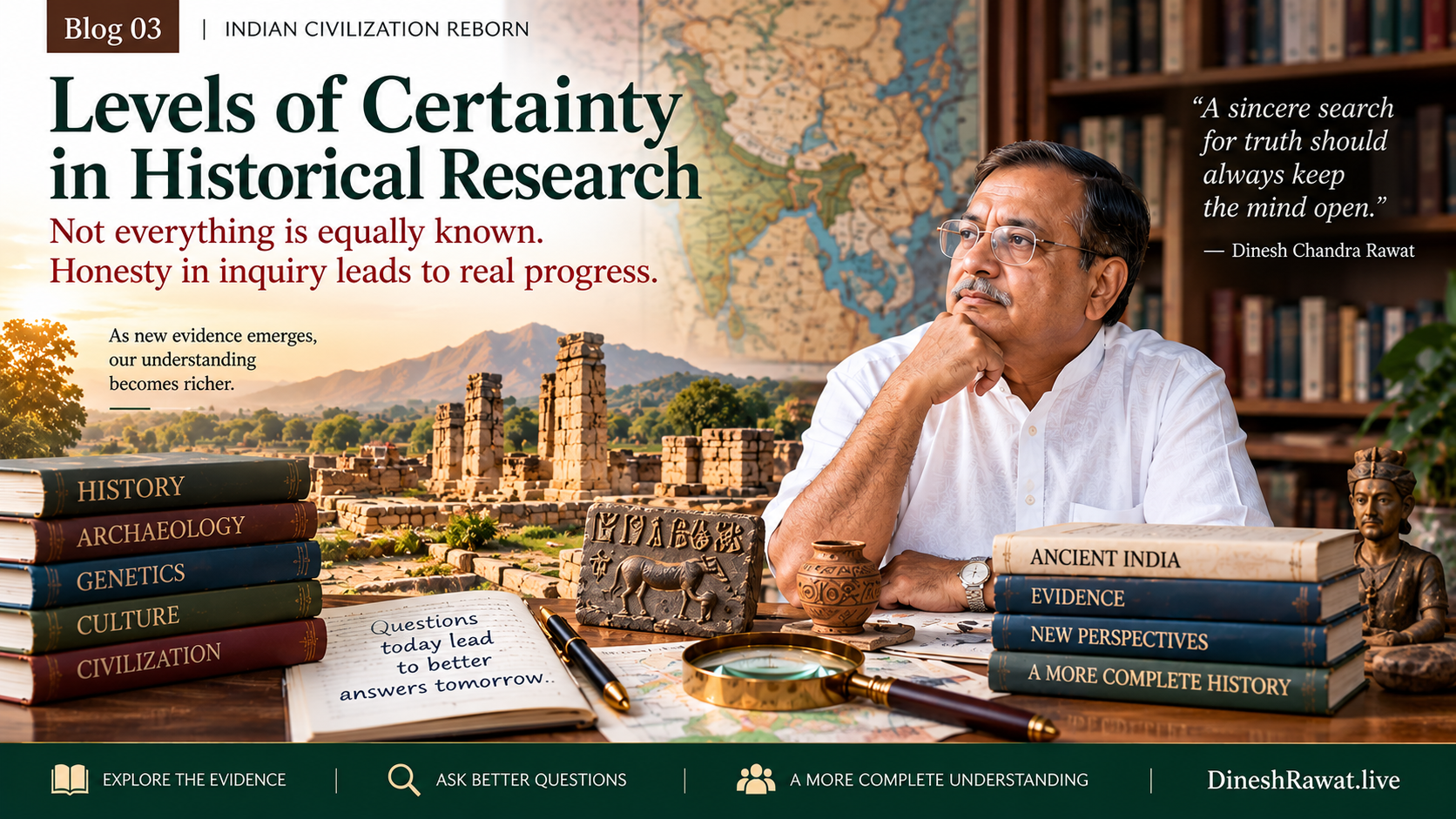
The Most Important Words in Historical Research: “We Do Not Know Yet”
There is a sentence that I have learned to respect increasingly during my years of historical exploration:
It may sound unsatisfactory.
For me, it represents intellectual strength.
History Naturally Contains Gaps
The past did not leave us a complete archive.
Buildings disappeared. Manuscripts were lost. Rivers changed course. Languages changed. Organic materials decayed. Archaeological sites remain unexcavated.
What survives is incomplete.
Historians therefore work much like investigators reconstructing an event from surviving fragments.
The difficulty begins when an interpretation formed from those fragments starts being presented as though no uncertainty remains.
Evidence Has Different Strengths
Not all evidence answers the same questions.
An archaeological structure may establish that people occupied a location.
A radiocarbon date can help establish chronology.
A text can preserve ideas, memories or descriptions.
Genetics can illuminate aspects of population history.
Geology can reconstruct an ancient landscape.
But none of these disciplines should automatically be asked to answer questions beyond its capacity.
This became increasingly important to me as I studied ancient Indian civilization.
The Saraswati Question Is a Good Example
Consider the Ghaggar–Hakra system and the ancient Saraswati.
Remote sensing, archaeology and geological research have substantially increased knowledge of ancient channels and settlement patterns. Yet identifying every geological feature directly with every textual description remains a more complicated question.
For example, a major Nature Communications study of the Ghaggar–Hakra palaeochannel found that a former Sutlej course had abandoned the studied palaeovalley before the urban Indus settlements developed there, while monsoon-fed seasonal flow continued in the relict valley. The relationship between geological evidence, archaeological settlement and textual identification therefore needs to be handled carefully.
The responsible position is neither to dismiss ancient textual memory automatically nor to announce that every element has been conclusively proven.
It is to investigate.
The Glories of India research article on the Ghaggar–Hakra debate is intended to place evidence and competing interpretations together rather than pretend the debate has disappeared.
Changing Your Mind Is Not Defeat
One unfortunate feature of public debate is that changing one’s mind is often treated as weakness.
Research requires exactly the opposite attitude.
If better evidence appears, our interpretation should change.
That is not surrender.
That is the purpose of investigation.
The same principle must apply to inherited historical interpretations and to modern claims intended to glorify ancient India.
Neither should receive immunity from evidence.
Why This Matters for Young Indians
I want young readers to feel pride in India’s civilization.
But durable pride should come from discovering what can genuinely be established.
Dholavira does not require fantasy. Its engineering survives.
Indian mathematical traditions do not require exaggeration. Their historical contributions can be documented.
The Harappan archaeological landscape does not need to be made impressive. It already is.
Our responsibility is to investigate it properly.
From Stop Teaching Rotten History to Indian Civilization Reborn
This is one of the bridges between my books.
Stop Teaching Rotten History asks whether inherited historical frameworks deserve reconsideration.
Indian Civilization Reborn goes further by bringing multiple kinds of evidence into the investigation.
The progression matters.
First we learn to question. Then we learn to compare evidence. Finally, we attempt reconstruction.
An Open Question Is Not an Empty Question
Some of the greatest advances in knowledge begin with uncertainty.
“We do not know yet” does not mean: Stop investigating.
It means: The evidence has not yet justified a final conclusion.
That sentence protects research from both dogma and enthusiasm.
I have reached many conclusions during my journey. I have also encountered questions where I believe more evidence is required.
I increasingly consider it important to tell readers which is which.
Because the purpose of studying history should not be to win an argument.
It should be to move closer to truth.
Key Takeaways
- Historical uncertainty is a legitimate part of serious research.
- Different disciplines answer different historical questions and have different limits.
- Changing an interpretation when better evidence appears is a strength, not a weakness.
- Civilizational pride and rigorous inquiry are compatible.
- An unresolved question is an invitation to further investigation, not an empty question.
Continue Exploring
On DineshRawat.live: Why I Stopped Accepting History as a Finished Story · My Books · Books & Research
Companion research: The Ghaggar–Hakra Debate on GloriesOfIndia.info.
Frequently Asked Questions
Is uncertainty a weakness in historical research?
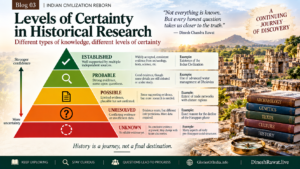
No. Clearly distinguishing what is established, probable, debated and unknown is a basic part of responsible research.
Can new evidence change history?
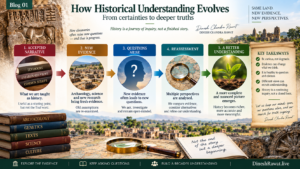
New evidence does not change the past, but it can change our reconstruction and interpretation of the past.
Does evidence-based history prevent civilizational pride?
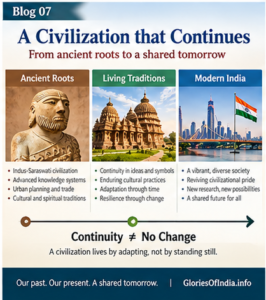
No. Evidence-based inquiry makes well-supported achievements more credible and helps separate them from exaggeration.
What connects Stop Teaching Rotten History and Indian Civilization Reborn?
The first encourages readers to question inherited narratives; the second develops the wider multidisciplinary investigation needed for responsible reconstruction.
Question the Past. Investigate the Evidence.
Begin with Stop Teaching Rotten History to examine how historical narratives are formed and challenged. Continue with Indian Civilization Reborn for the broader investigation of archaeology, geography, texts, science and living traditions.