
How One Question Changed the Course of My Life
There are moments in life that quietly alter everything.
Not through dramatic events, but through a single question that refuses to leave your mind.
For me, that question was surprisingly simple:
What if the history I had been taught was incomplete?
I never imagined that searching for an answer would take me across continents, into museums, archaeological sites, ancient libraries and conversations with scholars, eventually becoming a journey that has now lasted more than thirty-five years.
I Never Planned to Become a History Researcher
My career began in business, not history.
Like millions of Indians, I accepted what I had learned in school. Ancient Egypt, Mesopotamia and Greece were presented as the earliest great civilizations, while India’s past was often compressed into simplified timelines and familiar narratives.
I had no reason to question those accounts.
Business occupied my time, and life moved forward.
Then one unexpected discovery changed everything.
The Question That Would Not Go Away
While reading about ancient India, I came across references to the Saraswati River.
Ancient texts described it as a mighty river.
Yet modern maps showed no such river.
Was it purely symbolic?
Had it disappeared?
Or had something been overlooked?
The more I searched, the more questions emerged.
Instead of finding certainty, I found contradictions.
When Science Entered the Conversation
As technology advanced, new research began to appear.
Satellite imagery revealed buried river channels.
Archaeological excavations uncovered settlements older than previously believed.
Genetic research opened new discussions about population continuity.
Geological studies reconstructed ancient landscapes.
For the first time, history was no longer being explored only through written records.
Science had entered the conversation.
Every Discovery Raised New Questions
Rather than providing simple answers, each discovery encouraged deeper investigation.
If ancient settlements existed along dried river systems…
If archaeological evidence continued to emerge…
If new dating methods revised earlier assumptions…
Then perhaps history itself deserved another careful look.
I realised that understanding the past required an open mind and a willingness to follow evidence wherever it might lead.
Thirty-Five Years of Learning
What began as curiosity gradually became a lifelong commitment.
I travelled extensively across India and abroad.
I visited archaeological sites, museums, universities and historical landmarks.
I read widely—from ancient literature to modern scientific research.
Each journey expanded my understanding, but it also reminded me of how much remained to be discovered.
The greatest lesson was not certainty—it was humility.
Beyond Dates and Dynasties
History is often taught as a sequence of rulers, battles and political events.
But civilization is much more than that.
It includes:
- Rivers that sustained communities.
- Knowledge systems passed through generations.
- Languages that preserved ideas.
- Trade networks connecting cultures.
- Scientific achievements.
- Spiritual traditions.
- The relationship between people and nature.
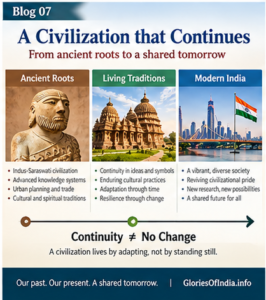
The more I explored, the more I understood that civilization is a living continuum rather than a collection of isolated events.
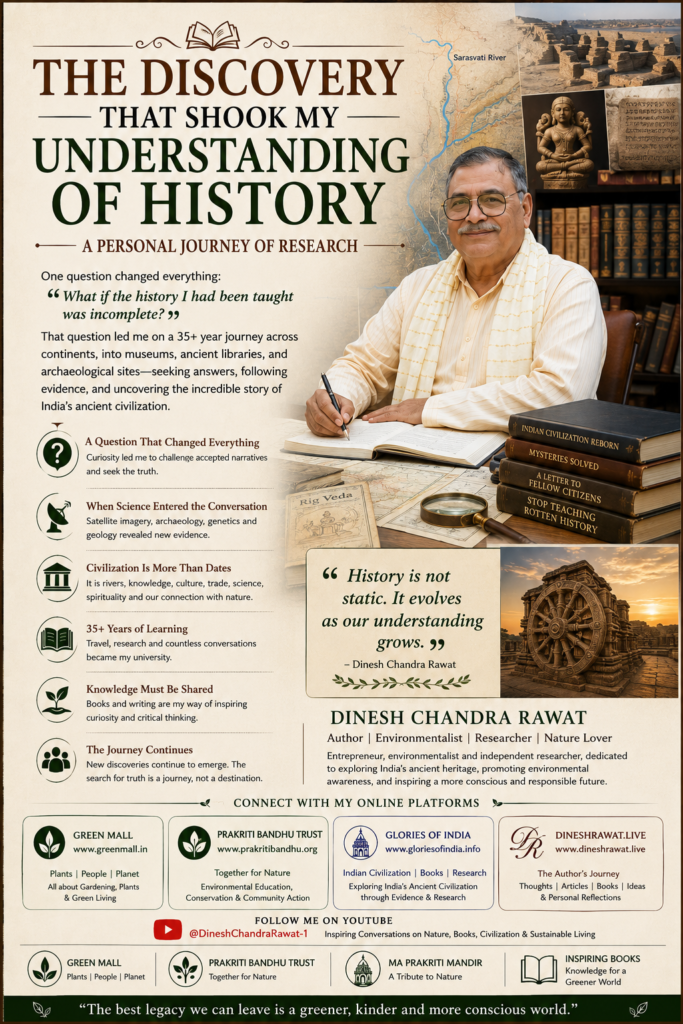
Why I Began Writing
Friends often asked why I spent so much time researching.
The answer was simple.
Knowledge gains meaning only when it is shared.
Books became my way of bringing together years of reading, travel and observation.
Not to tell readers what to believe.
But to encourage them to ask better questions.
The Journey Continues
Even after decades of research, I do not believe the journey is complete.
New discoveries continue to emerge.
New technologies provide fresh insights.
New evidence invites further investigation.
History is not static.
It evolves as our understanding grows.
That is what makes it endlessly fascinating.
My Hope for Future Readers
I hope readers approach history with both curiosity and humility.
Question respectfully.
Examine evidence carefully.
Remain open to new discoveries.
Civilizations deserve to be understood through the best knowledge available—not merely repeated assumptions.
The search for truth is a journey, not a destination.
Key Takeaways
- A single question can change the direction of a lifetime.
- Scientific discoveries continue to reshape our understanding of history.
- Archaeology, geology and satellite technology are transforming historical research.
- Curiosity is one of the most valuable qualities of any researcher.
- Understanding civilization requires evidence from many disciplines.
Continue the Journey
If this article resonates with you, you may also enjoy:
- Why I Chose Nature Over Business Expansion
- My Journey from Entrepreneur to Researcher
- Lessons Learned from Visiting More Than 60 Countries
- Why I Started Writing Books
- What Ancient India Taught Me About the Future
Explore My Work
This article reflects the ideas behind several of my ongoing projects:
- Green Mall – Promoting sustainable gardening and landscaping.
- Prakriti Bandhu Trust – Environmental education and conservation.
- Ma Prakriti Mandir – Celebrating humanity’s connection with nature.
- Green Guru Knowledge Series – Books that inspire greener living.
About the Author
Dinesh Chandra Rawat is an author, entrepreneur, environmentalist and independent researcher. Over more than thirty-five years, he has travelled extensively, studied archaeological discoveries, explored historical sites and written on topics ranging from environmental conservation to Indian civilization. His work seeks to inspire curiosity, critical thinking and a deeper appreciation of humanity’s shared heritage.